Tin tức
Why “just logging in” to OKX is a decision, not a click: practical rules for US traders
Misconception first: many traders treat an exchange login like any other web app — a username, password, maybe 2FA — and assume risk is trivial. That’s the wrong mental model. With OKX you’re not only unlocking an interface for spot and derivatives trading; you’re choosing between custody models, cross‑chain plumbing, regulatory friction, and trade execution environments that behave very differently in stress. This article explains the mechanisms behind OKX’s login and account choices, points out where that process limits or exposes you, and gives practical heuristics US traders can use every time they sign in.
Think of the login step as the gateway to three linked systems: centralized custodial accounts (the CEX), a non‑custodial Web3 wallet, and a DEX/DeFi layer. Each has different security trade‑offs, recovery properties, and operational costs. Your login choice determines what you can do quickly (trade perpetuals, stake, move across chains), what you must verify (KYC), and what risks you inherit (phishing, seed loss, smart contract exploits).
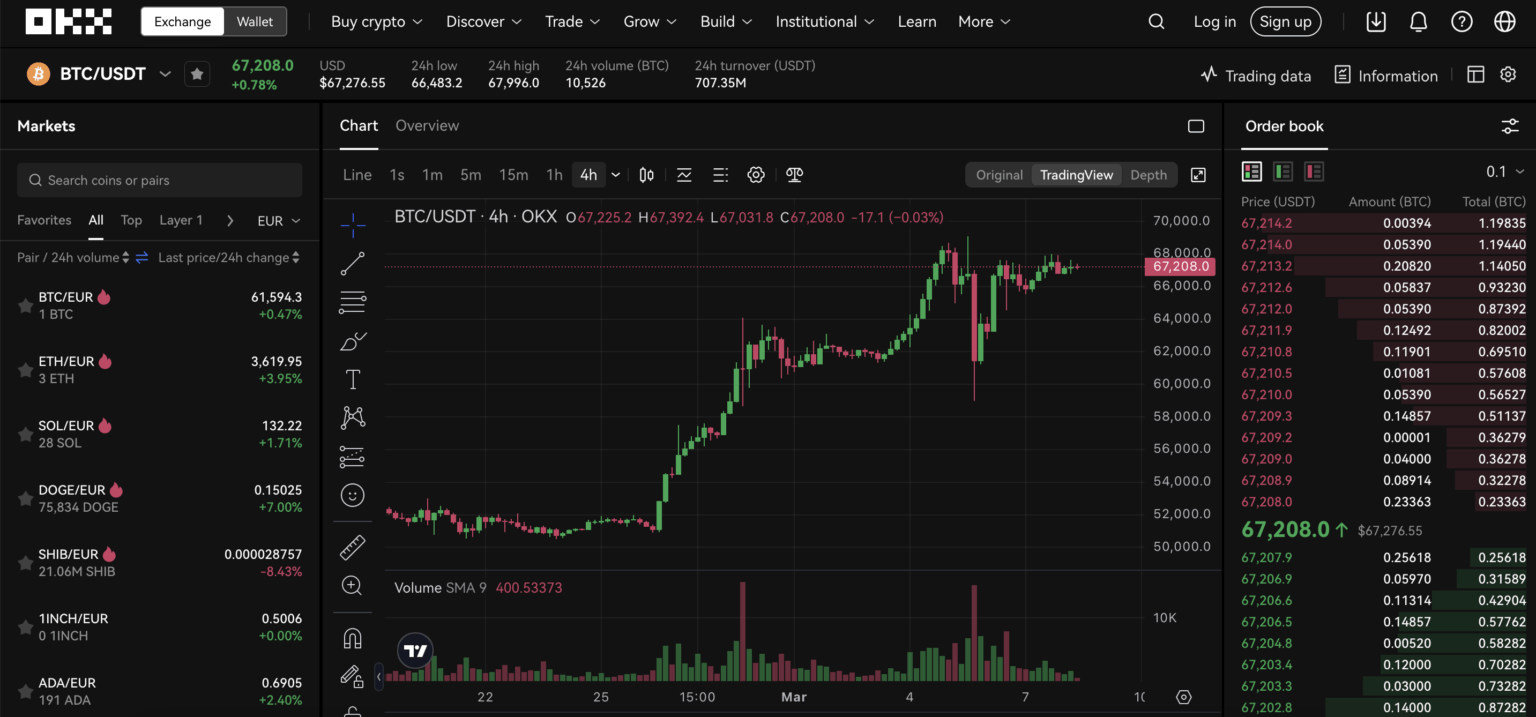
How OKX login maps to custody, features, and constraints
Mechanism first: when you log into OKX you either access a custodial account on the exchange (CEX) or connect a self‑custodial Web3 wallet. Custodial accounts require KYC (ID and a liveness facial check in most jurisdictions) and are covered by the exchange’s internal protections — including Proof of Reserves transparency and a policy of storing over 95% of assets in offline, air‑gapped, multi‑signature cold wallets. That structure reduces counterparty risk from theft but creates regulatory exposure: withdrawals and product access can be constrained by compliance checks or delistings (OKX recently removed several low‑volume spot pairs as part of routine pruning, a reminder that asset availability on a CEX changes over time).
Non‑custodial login (connecting a seed phrase or hardware wallet) hands private key control to you. It removes the exchange as a counterparty risk for custody, but it adds operational risks — phishing, permanent loss of access if the seed phrase is lost, and smart contract vulnerabilities when you use DeFi features. OKX’s Web3 wallet supports hardware integrations (Ledger, Trezor) and a browser extension, which is convenient but still requires disciplined key management.
Practical trade-offs: convenience, security, and product access
Three trade-offs matter for US traders: speed vs. safety, control vs. convenience, and feature breadth vs. compliance friction. If you prioritize low friction and deep liquidity for futures and options, a KYC‑verified custodial account is the practical choice: instant fiat/crypto rails (where available), margin and up to 125x leverage on some instruments, and access to staking, NFT markets, and the DEX aggregator inside one interface. But that convenience means your assets sit inside OKX’s operational perimeter — usually safe, but not immune to access limits or compliance holds.
On the other hand, if you want maximum sovereignty and permissionless access to thousands of DApps and cross‑chain swaps, use the non‑custodial wallet path. That route is better for interacting with DeFi yield farming, using the DEX aggregator to source liquidity cross‑chain, and retaining recovery responsibility via seed phrase and hardware wallets. The downside: you alone bear the finality risk of lost keys or exploited smart contracts.
Login security: what the systems actually do — and don’t — protect against
OKX applies several defensive mechanisms at login: military‑grade encryption, AI‑driven anomaly detection for suspicious sign‑ins, and mandatory two‑factor authentication (SMS, Google Authenticator, or biometrics). In practice these work well against mass credential stuffing and automated attacks. But they are not a panacea. Phishing remains the most common attack vector: a convincing fake page that captures your credentials or prompts wallet signing will bypass two‑factor protections if you approve it. Similarly, biometrics secure a device but do not help if your seed phrase is compromised on a desktop.
Operationally, the best defense is layered: use a KYC custodial account with strong 2FA and withdrawal safelists for fiat or large transfers; separate routine trading funds from long‑term holdings (which can live in the self‑custodial wallet); and lock high‑value seed phrases in hardware devices and offline storage. Think in terms of compartmentalization — limit what any single credential can unlock.
Decision heuristics: a short checklist before every OKX sign‑in
1) What am I doing? Quick trade, large withdrawal, chain bridge, or DeFi interaction? Keep high‑risk moves on accounts/wallets appropriate to that function. 2) Which custody model fits this task? Use custodial for margin/futures and fiat rails, use non‑custodial for direct DApp interactions. 3) Is 2FA enabled and is my device clean? Always yes. 4) Am I interacting with a contract or signing a transaction? Pause and verify the contract address and the permission scope — revoke approvals you no longer need. 5) For large balances, does Proof of Reserves or cold‑wallet policy make me comfortable with counterparty custody? If not, migrate to self‑custody or split holdings.
These few questions create a mental model that converts login from reflex into an informed operational decision. The best traders make these evaluations automatic — not because they distrust OKX, but because different pathways carry different failure modes.
Where the system breaks and what to watch next
Limitations are important. Delistings (like the recent removal of several low‑volume spot pairs) show that an asset’s availability on the exchange is not permanent — if your strategy depends on obscure tokens, plan for on‑exchange illiquidity and transferability. Cross‑chain bridges and the DEX aggregator are powerful, but they inherit smart contract risk and bridge fragility; using them increases attack surface. Proof of Reserves improves transparency but does not prevent operational outages or regulatory freezes on withdrawals.
Signals to monitor in the near term: further asset pruning (which narrows the available spot universe), changes to KYC policies that could affect US users, and adjustments to margin/leverage rules in response to volatile markets. Each of those shifts changes the cost‑benefit calculus for whether to prefer custodial or non‑custodial access.
Where this fits compared to alternatives
Compared with smaller boutique exchanges, OKX offers broader product variety (staking, NFT marketplace, DEX aggregator, futures, and a Web3 wallet), stronger institutional features, and the convenience of an integrated interface. Versus pure self‑custodial flows (hardware wallet + direct DEX use), OKX’s custodial route is simpler and faster for market access but adds counterparty concentration. For US traders who need margin and derivatives, OKX’s product set and trading infrastructure often justify the custodial trade‑off — provided rigorous login hygiene and compartmentalization are adopted.
One non‑obvious insight: using both custody models in parallel — a funded custodial account for active trading and a segregated self‑custodial wallet for long‑term positions — often delivers the best balance of liquidity and security. It requires disciplined fund movement but dramatically narrows single‑point failure risk.
FAQ
Do I need KYC to use OKX in the US?
Yes. To access custodial trading features, fiat rails, and most exchange products you will need to complete identity verification, which typically involves a government ID and a liveness facial check. Non‑custodial wallet access to Web3 features may be possible without KYC, but those actions carry different operational risks and do not provide exchange custody protections.
Which 2FA should I use for the best balance of security and convenience?
Use an authenticator app (Google Authenticator or similar) rather than SMS where possible; app‑based 2FA resists SIM swap attacks. Biometrics on your mobile device are convenient and strong locally, but they should be paired with an authenticator and, for large withdrawals, additional withdrawal whitelist controls.
Is OKX safe for staking or yield farming?
OKX supports flexible and fixed‑term staking with auto‑compounding as well as DeFi yield options. Staking through OKX’s custodial services reduces counterparty risk due to cold storage and multi‑sig controls, but DeFi yield farming accessed via the Web3 wallet exposes you to smart contract risk and impermanent loss. Decide based on whether you prefer operator‑managed custody or direct protocol exposure.
How should I handle delistings or asset pruning?
Treat delistings as operational risk. If you hold low‑volume tokens on a custodial account, have an exit plan: either convert to a stablecoin or withdraw to a self‑custodial wallet before liquidity dries up. Monitor exchange announcements and avoid relying on obscure pairs for critical payoffs.
Final takeaways
Logging into OKX is not a neutral step — it routes you into different custody regimes, regulatory constraints, and risk profiles. For US traders the pragmatic rule is to pick custody according to task: custodial for high‑frequency trading and derivatives; non‑custodial for long‑term, cross‑chain, or DeFi exposure. Compartmentalize funds, harden device and 2FA hygiene, and treat each approval or signature as a transaction with security consequences.
If you want a concise how‑to for the available login paths and their operational impacts, start on the platform’s login page and review recovery and 2FA options before moving significant funds. For a step‑by‑step guide to the web login flow and quick links, see this resource on okx.